
Monsters as Queer Methodology
Queer Curation in Practice in The Horror Show! A Twisted Tale of Modern Britain
In his book Skin Shows: Gothic Horror and the Technology of Monsters, Jack Halberstam positions monsters as “meaning machines.” As a symbol of multiplicity, monsters trouble categories and disrupt boundaries, facilitating a range of interpretations by taking on multiple identities within a single body. Monsters are representations of cultural fears and anxieties, and as such can take on new meanings between individuals and across time. The first thesis of Jeffrey Jerome Cohen’s monster theory—the monster’s body is a cultural body—also reflects upon these ideas. Cohen writes:
“Like a letter on the page, the monster signifies something other than itself: it is always a displacement, always inhabits the gap between the time of upheaval that created it and the moment into which it is received, to be born again.”
Monsters don’t produce fears so much as they reflect them. They are mirrors, or stand-ins, for the dominant fears and anxieties of the cultural moment in which they are invoked. Take a moment to think about your favourite monsters: what fears and anxieties have they been used to speak to, and how have they evolved since their inception?
I would also suggest, however, that we have entered an increasingly monster-positive period, where monsters are being invoked in media to represent the marginalized, not as subjects to be feared but to be sympathized with. This is not to say that this is a new concept. Mary Shelley, most iconically, troubles our understanding of the monster through the Creature in Frankenstein, calling into question who the real monster is. Similarly, readings of classic monsters, like vampires, werewolves, and zombies, from queer, feminist, critical race, and disability perspectives highlight their resonances with contemporary audiences as tools for both challenging narratives that seek to ostracize and “other” groups of people while also being sites for belonging and acceptance of our own “monstrosities.” It is through this embracement of monsters, I argue, that we can begin to disrupt traditional constructions of knowledge and history that seek to dictate who does and does not belong, and make visible the stories of marginalized communities.
Outside of film and literature, one place where this construction of knowledge and history takes place is in exhibition spaces like galleries, libraries, archives, and museums (GLAM). Exhibitions allow for art, artifacts, and other pieces of material culture to be made visible to the public through a curated narrative, facilitating GLAM institutions’ mission of preservation and access. However, these are far from neutral spaces. The role of the curator in the process of constructing these textual and visual narratives is a weighted one. Questions of what gets included and excluded, how objects are classified and described, how the exhibition is structured both narratively and physically, and who is doing the curating are all aspects of curation that impact what stories are told and how they are told. Much as monsters have been used to delineate normativity and reinforce negative power structures through the act of othering, many GLAM institutions continue to play a part in upholding often colonial, white supremacist, cisheteropatriarchal narratives. These institutions’ responses to calls for increased inclusivity have the potential to challenge this status quo, but is inclusivity enough when the foundations that underpin concepts of stewardship, preservation, curation, and access in cultural heritage spaces are still deeply rooted in oppressive systems?
To this I ask: How can monsters help us rethink the possibilities of how we communicate our histories?
One example in which these questions are put into practice is in the exhibit The Horror Show! A Twisted Tale of Modern Britain, on display at Somerset House between October 2022 and November 2023. To me, this exhibit exists at the intersection of queer theory and Cohen’s monster theory, highlighting how intrinsically linked queerness and monsters are. After a brief overview of the exhibit, I will be drawing from some queer museums and archival literature, alongside monster theory, to showcase how, by engaging with the histories of marginalized communities, co-curators of The Horror Show were able to utilize monsters to challenge the rigid and often essentializing constructions of knowledge and history that many GLAM institutions are guilty of perpetuating.
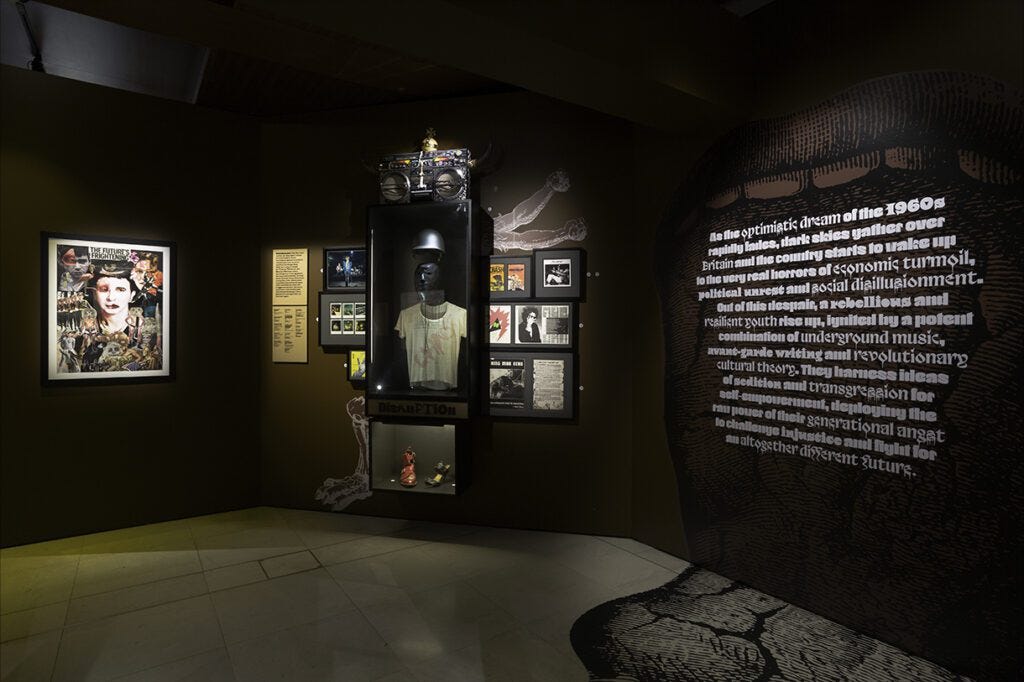
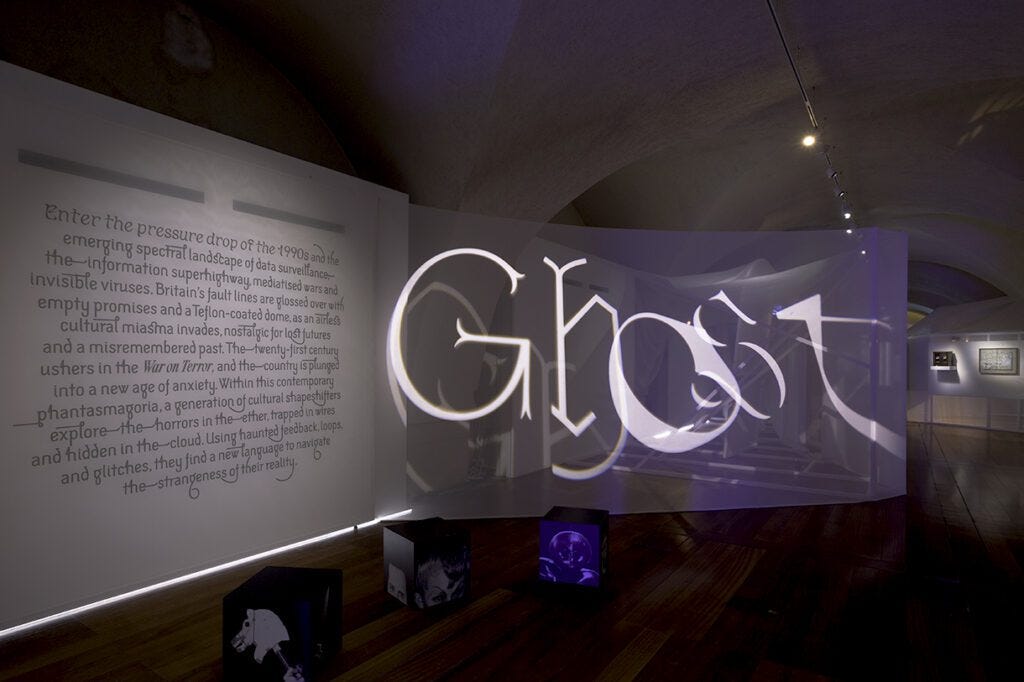
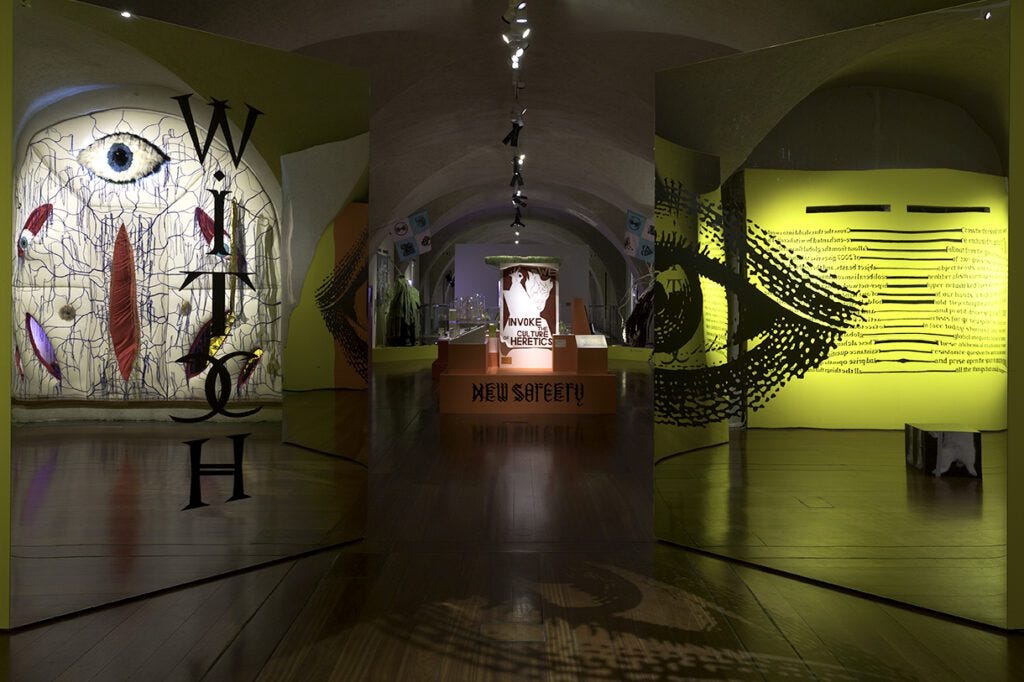
Co-curated by Ian Forsyth, Jane Pollard, and Claire Catterall, The Horror Show presents an alternative perspective on the last five decades of British culture through its artists’ engagement with horror themes and imagery in their work as a reaction to the turbulent social, political, and economic environments they lived in. More than just the art and artifacts on display, however, the curators use monsters as a narrative device for the exhibition. Broken down into three acts, the curators bring forth the archetypes of the monster, the ghost, and the witch to illuminate artists’ anxieties, fears, and hopes during particular moments in British history
The first act opens with the Monster, set against the backdrop of the political unrest, economic upheaval, and social disillusionment that defined the 1970s and 80s. Here, the curators construct a dual image of the monster. On the one hand, there are those deemed monstrous by those in power. These are the rebellious youth, the transgressive artists, and the revolutionary thinkers that make up the body of work on display in the exhibition. On the other hand, the exhibition also points to the monsters of today, shifting monstrosity away from traditional constructions of the monster as the outsider, and instead, towards those in power who uphold hegemony and seek to define who does and does not belong.
The second act utilizes the spectral and ephemeral nature of the ghost to trace the transition into the digital age in the 1990s and early 2000s. The curators describe the youth of this era as “cultural shapeshifters,” having to navigate the new horrors of the ether, using new language to adapt to a shifting landscape of increased surveillance, faceless audiences, and invisible cyberwars.
Finally, tracing history from the 2008 financial crisis to the present, the exhibition closes with the witch, positioning the younger generation as a hyper-connected coven, committed to the abandonment of the “patriarchal occult” and the “zombie doctrine of neoliberalism” with an emphasis on embracing bodily autonomy and a groundedness rooted in a climate justice-centred value system. In this final act, the curators highlight the potential of creative resistance for shaping our current reality and reimagining the future.
The curators’ use of monsters in The Horror Show enables a queering of history. To explore specifically what I mean by “queer” within the context of curatorial practices, I will turn to Robert Mills and his 2008 article, “Theorizing the Queer Museum.” In this article, Mills poses a vision of the queer museum that goes beyond universalist conceptions of queer identity and desire, which often reduce the queer experience to linear “in” and “out” binaries, and instead calls for a shift towards a perspective of queerness as a practice to be enacted. To theorize the queer museum, Mills suggests, is to challenge the very role of the museum as a norm-producing, meaning-making institution.
Much as Cohen frames the monster as a cultural body that exists to be read, Mills frames queerness as a positionality rather than a positivity. Meaning that queerness, like monsters, resists meaning, only becoming visible when set against the backdrop of “the normal, the legitimate, the dominant, and the coherent.” Further, Mills describes the “subversive promise” of queerness as a tool for challenging the normative structures that define traditional museum practices. Monsters, I would argue, are similarly committed to a subversive promise of their own. As Cohen describes the monster in his third thesis—the monster is the harbinger of category crisis—monsters are “full of rebuke for traditional methods of organizing knowledge and human experience,” with a “refusal to participate in the classificatory order of things,” making them a unique tool for resisting the essentializing and often exclusionary constructions of knowledge and history established by cultural heritage institutions.
Unlike traditional curatorial practices that, according to Mills, aim for “coherence, objectivity, and clarity” for the viewing ease of the visitor, monsters in The Horror Show are used as a disruptive narrative device, forcing the visitor to engage with the horror themes of the exhibition, which rely heavily on metaphor and interpretation rather than fact and objectivity. While the exhibition is temporally linear, going from the 1970s to the present, by relying more on affective responses to particular times in history rather than material evidence, it constructs a history that is fluid rather than fixed.
This emphasis on affect is central to José Esteban Muñoz’s 1996 article, “Ephemera as Evidence: Introductory Notes to Queer Acts.” In this paper, Muñoz explores what traditionally counts as evidence in academic scholarship and historical narratives, highlighting how integration of performance, anecdote, and emotion is often brushed aside or delegitimized because they lack the “rigour” of material evidence. Muñoz aims to interrupt constructions of rigour and, as the title suggests, bring forth ephemera as evidence.
He defines ephemera as follows, writing:
“Ephemera […] is linked to alternate modes of textuality and narrativity like memory and performance: it is all of those things that remain after a performance, a kind of evidence of what has transpired, but certainly not the thing itself. It does not rest on epistemological foundations but is instead interested in following traces, glimmers, residues, and specks of things.”
Queerness and other forms of alterity have historically had to be expressed covertly, leaving little material evidence behind; Ephemerality was a survival tactic. What Muñoz is suggesting is that by bringing forth ephemera as evidence, in the form of memory or performance, those whose existence has been forced to hide in the shadows can come forward and assert their existence in the historical narrative.
As articulated in Cohen’s second thesis—the monster always escapes—monsters themselves are ephemeral. According to Cohen, “monstrous interpretation is as much process as epiphany, a work that must content itself with fragments.” The Horror Show works with this monstrous ephemerality by constructing the exhibit in three acts, giving it a performance-like quality that, like in film or stage productions, emphasizes the experience it leaves the audience with rather than prescribing meaning or asserting proof of something. The monstrous body in the exhibition evolves from the capital “M” monster to the ghost and finally the witch, relying not on material evidence of the events of the time periods they represent but on individual feelings and collective reactions to moments in time. These experiences are then made visible by walking through the exhibit. Therefore, by engaging with monstrous ephemerality, The Horror Show opens up new possibilities for the telling of history by minority communities that have traditionally been excluded from historical narratives.
Whether or not the curators explicitly engaged with monster theory and queer theory in the creation of this exhibition, the monsters, as they tend to do, speak for themselves. Positioning monsters as queer methodology highlights the generative potential of monsters, making them valuable tools for challenging rigid structures that often define colonial, white supremacist, and cisheteropatriarchal constructions of knowledge and history. Subversive and transgressive in nature, monsters, as articulated in Cohen’s final thesis, truly “stand on the threshold of becoming,” and this space of possibility is a powerful one. Monsters certainly aren’t going anywhere. They will continue to trouble and challenge our understandings of our relationships with each other and ourselves. They will also continue to be sites for resistance and finding belonging. As linkages to our past and gatekeepers to our future, what monsters have to say is important. So, keep on listening, who knows what they might tell you.
References
Cohen, J. J. (1996). Monster theory : reading culture. University of Minnesota Press.
Forsyth, I. & Pollard, J. (n.d.) Curated exhibition: The horror show!. https://iainandjane.com/portfolio-item/the-horror-show/
Mills, R. (2008). Theorizing the queer museum. Museums & Social Issues, 3(1), 41–52. https://doi.org/10.1179/msi.2008.3.1.41
Muñoz, J. E. (1996). Ephemera as evidence: Introductory notes to queer acts. Women & Performance, 8(2), 5–16. https://doi.org/10.1080/07407709608571228
Somerset House. (n.d.) The horror show! A twisted tale of modern Britain. https://www.somersethouse.org.uk/whats-on/the-horror-show.
A very interesting perspective for sure, thank you Julia
You're an excellent writer, wow